Introducing Kadma Advanced Materials: the company behind Concretene and Mirogo
Kadma Advanced Materials brings Concretene and Mirogo together under a new corporate identity, reflecting the company’s development from a concrete-focused technology business into a broader advanced-materials organisation.
Kadma brings our two brands together under a new corporate identity, reflecting the company’s development into a broad advanced-materials organisation.
Kadma Advanced Materials brings Concretene and Mirogo together under a new corporate identity, reflecting the company’s development from a concrete-focused technology business into a broader advanced-materials organisation.
Our work began with Concretene and a clear technical and commercial challenge: could graphene be made to work reliably in concrete, at industrial scale and at a cost that could be justified by the performance it delivered?
That question has shaped several years of formulation development, laboratory testing and commercial-scale trials. It has also led us into a wider area of materials science.
As our understanding of graphene feedstocks, dispersion, functionalisation and manufacturing has developed, so has the range of applications we can address. Kadma Advanced Materials provides a corporate identity broad enough to bring that work together while preserving the focus and recognition established by Concretene.
Two platforms, one company
Concretene continues as our platform for graphene-enhanced admixtures used in concrete, mortar and other cementitious materials.
Its development has focused on translating the properties of graphene into outcomes that matter to producers and asset owners: improved strength development, lower cement requirements, greater productivity and reduced embodied carbon. The products are designed to fit established batching and production processes, providing a practical route to adoption across readymix concrete, precast products, mortars and infrastructure applications.
Mirogo is our tuneable graphene oxide platform. It grew from the need for greater control over batch reliability and chemical functionality of graphenic materials and their interaction with different industrial systems.
By controlling the degree and location of oxidation, Mirogo is being developed to deliver different combinations of dispersibility, compatibility, conductivity and mechanical performance. This creates potential applications across coatings, advanced composites, printed electronics, energy storage and other sectors in which conventional graphene oxide or reduced graphene oxide can be constrained by cost, manufacturing complexity or damage to the underlying graphene structure.
Together, the two platforms reflect a common approach: advanced materials need to work consistently, integrate into existing processes and offer a credible route to commercial scale.
A broader identity for the organisation
Kadma Advanced Materials will become the principal identity for the company, its team, partnerships and wider technology portfolio.
Concretene and Mirogo will retain their individual names and established visual identities. Existing product programmes, customer relationships and research collaborations will continue under the appropriate brand.
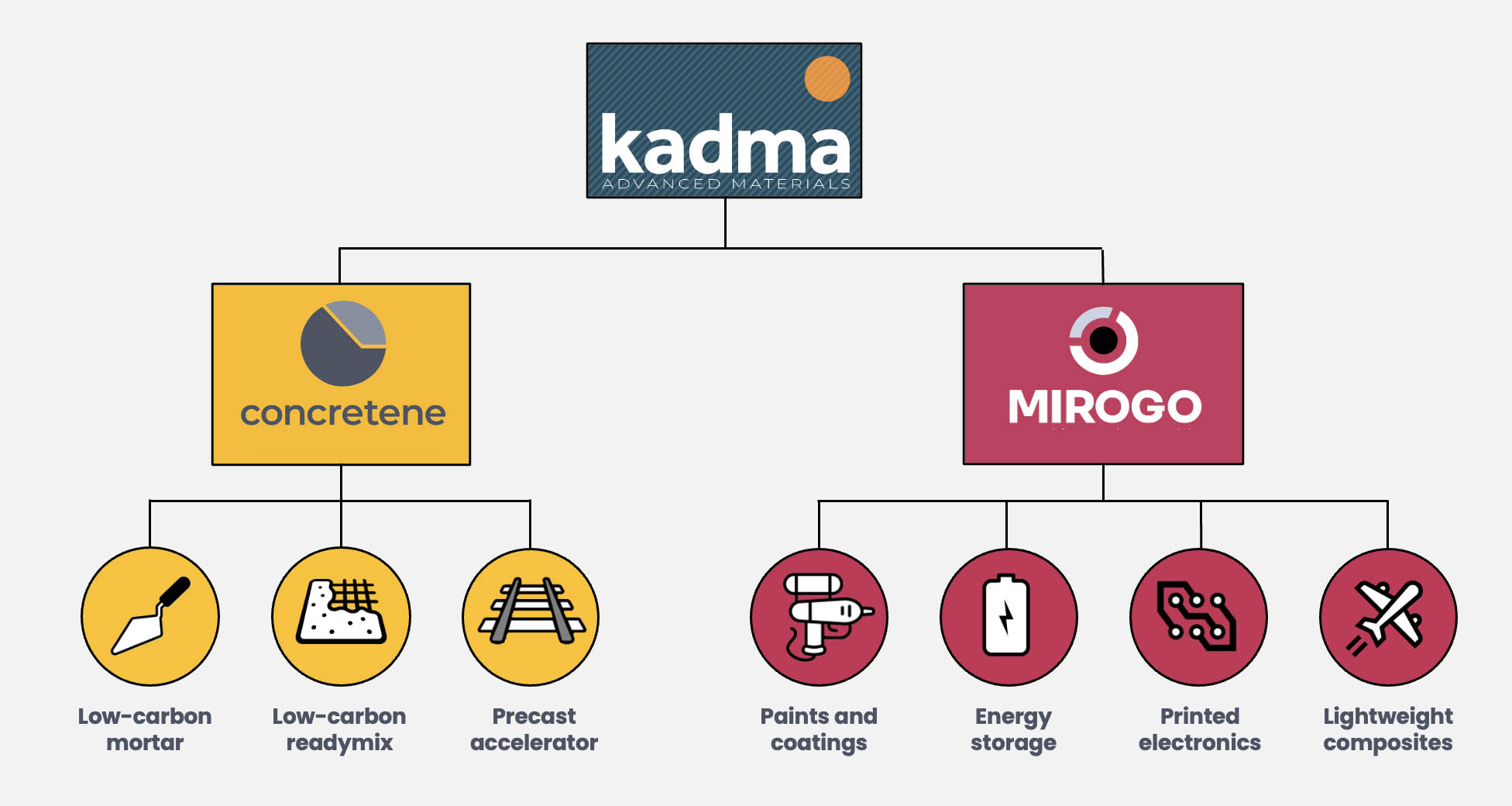
The change provides a clearer structure for communicating the breadth of the organisation:
Kadma Advanced Materials is the company behind the technology.
Concretene is our graphene-enhanced admixture platform for cementitious materials.
Mirogo is our tuneable graphene oxide platform for construction and wider advanced-material applications.
The team, ownership and existing commercial commitments remain unchanged. Current contracts and formal arrangements also remain valid.
Kadma Advanced Materials is currently a trading name of Cobmore Holdings Limited, which remains the underlying legal entity until a formal change is completed during Q4 2026.
Sustainable materials that work at scale
The shared purpose behind Kadma is straightforward: to solve industrial problems using sustainable, low-cost advanced materials that can be produced and deployed at meaningful scale.
This means looking beyond headline laboratory results. Materials must be manufactured repeatably, incorporated into real production environments and validated against the technical, commercial and regulatory requirements of their target markets.
Concretene has followed that path through its development of graphene formulation in concrete and mortar in extensive laboratory and scaled trials. Mirogo is now extending the same philosophy into a broader range of industrial systems, supported by work on continuous manufacturing, characterisation and application-specific validation.
First public appearance in the United States
Kadma Advanced Materials will make its first major public appearance at the Advanced Materials Show USA in Pittsburgh from 5-7 October 2026.
The event will provide an opportunity to present Concretene and Mirogo together for the first time under the Kadma identity and to begin new conversations with manufacturers, technology partners and end users across North America.
Concretene wins £1m Ofwat funding for low-carbon tech
Partnership with United Utilities, Tarmac and Levidian to use wastewater biogas as graphene feedstock
On 19 May 2026, Concretene was named as a winner in the sixth Water Breakthrough Challenge by Ofwat’s Water Innovation Fund.
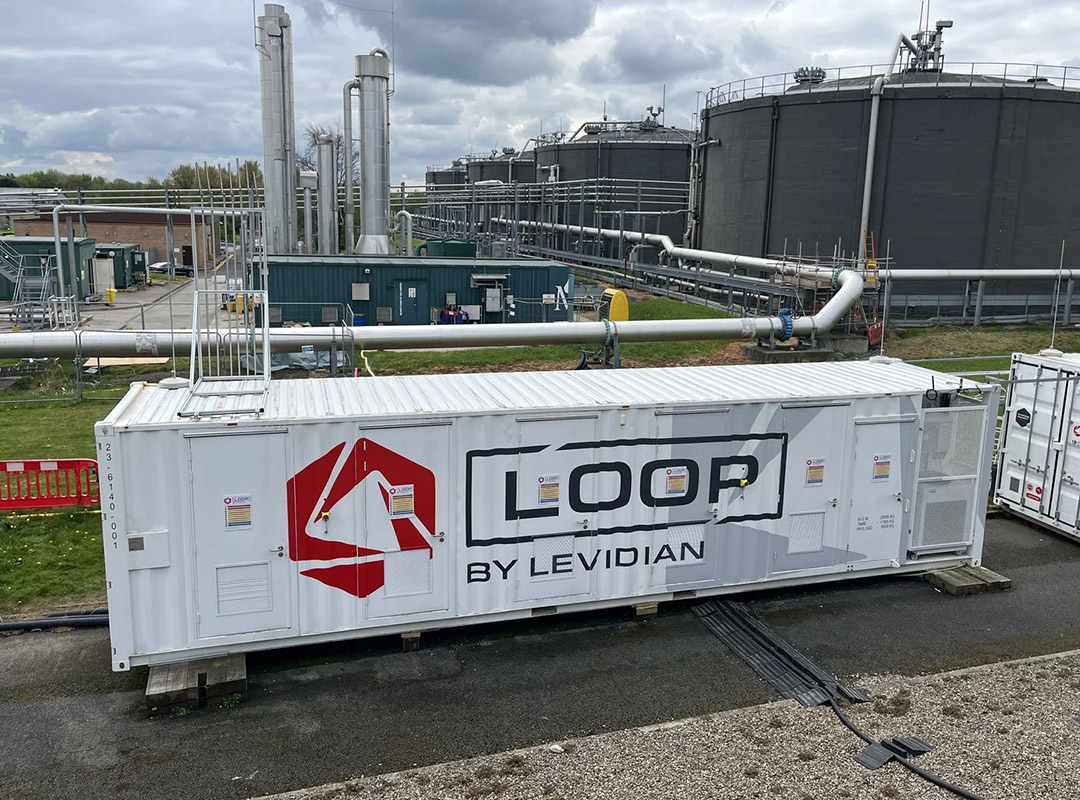
The project, Splitting Biogas, Multiplying Value, is a collaboration led by United Utilities from its Davyhulme wastewater treatment works in Manchester (pictured). Partners alongside Concretene include Tarmac, graphene producer Levidian, ULEMco (hydrogen economy) and Carbon Ion (battery tech). Four other water companies, Anglian, South-West, Wessex, Yorkshire, are included in the project, with the total award amounting to £10 million, of which Concretene’s share is £1m.
Graphene has been proven to enhance the material properties of concrete, allowing for reductions in cement – the most carbon-intensive ingredient – without adversely affecting strength and durability. However, the key barrier to widespread adoption of the technology is repeatability of performance at scale, with limitations relating to reliability of raw material supply.
Graphene is most commonly derived from graphite, of which the UK has no industrial-scale source, and imported graphite has a high environmental footprint from mining and processing. Concretene’s product development work has also shown that commercial graphene materials produced from mined graphite demonstrate high batch-to-batch variation.
The solution comes via innovative processing of wastewater derived biogas, via Levidian’s LOOP process, using microwave energy to split methane into solid carbon and hydrogen. This “bottom-up” approach delivers carbon in the form of highly consistent graphene nanoplatelets. Being derived from biogas and powered by renewable electricity, this graphene production technology delivers a significant net CO2 reduction compared to other graphene and performance-carbon production methods. Application specialists such as Concretene can use this material to deliver lower-carbon concrete infrastructure to the water sector.
Laboratory tests and scaled trials of Concretene admixture using graphene derived from biogas have shown savings of 15-20% in cement are achievable, with Concretene offering users cost-neutrality at scale, i.e. the price of the admixture equals the cost of cement saved. This addresses the other major hurdle to commercial adoption of graphene in concrete: high cost in a commodity sector.
Mike Harrison, CEO of Concretene, said: “It’s a big milestone for us to have developed a born-in-Manchester technology to the stage where we can partner with a major asset owner such as United Utilities. These trials will demonstrate the benefit of our product towards the shared goal of reducing the impact of construction on the climate.”
Ian Hopkins, Chief Commercial Officer of Levidian, said: “Following the successful trial of our LOOP technology at United Utilities’ Davyhulme site, it’s exciting to see Concretene’s graphene-enhanced admixture moving closer to real-world deployment in the water industry. We’re proving that advanced materials can be produced locally, at scale, to support the next generation of low-carbon infrastructure.”
Richard Clarke, United Utilities Programme Manager (Engineering Innovation), said:
“This project offers exciting potential to support the development of new, lower carbon products, including concrete, both for the water sector and other industries. More specifically, the availability of graphene from a fully sustainable biogas feed source can directly support both Concretene and our own advances towards net zero.”
UK Concrete Show 2026: costs and supply chain to the fore
Enthusiasm for graphene-enhanced concrete grows among industry as front-runner materials emerge
On 25-26 March, we spent a highly profitable two days at The UK Concrete Show at the NEC in Birmingham./
Notwithstanding some disruption on trains from the north, the show was very well attended. Our session with CEO Mike Harrison speaking on the unit economics of graphene was standing-room-only, and we had a constant stream of visitors to our stand, from students and lecturers to contractors, cement and chemical manufacturers and investors, all keen to learn more about our CO2-saving admixture.
There was notable support for our position on – and efforts towards achieving – cost-neutrality for customers, and an increasing understanding of the need for conditional offtakes (aka Advanced Market Commitments) from major industry players to enable innovative SMEs like ourselves to achieve scale.
We were grateful to Matt Dodd at organisers QMJ for all his organisational help and to everyone at Concretene who took part and/or made materials for the show - it was real team effort.